Convenience isn’t the enemy, what’s in it matters
What a recent children’s nutrition study actually found, why a freezer is not a food verdict, and how to keep practical choices on the menu.
Illustrative story: Lena is fictional, not a customer testimonial.
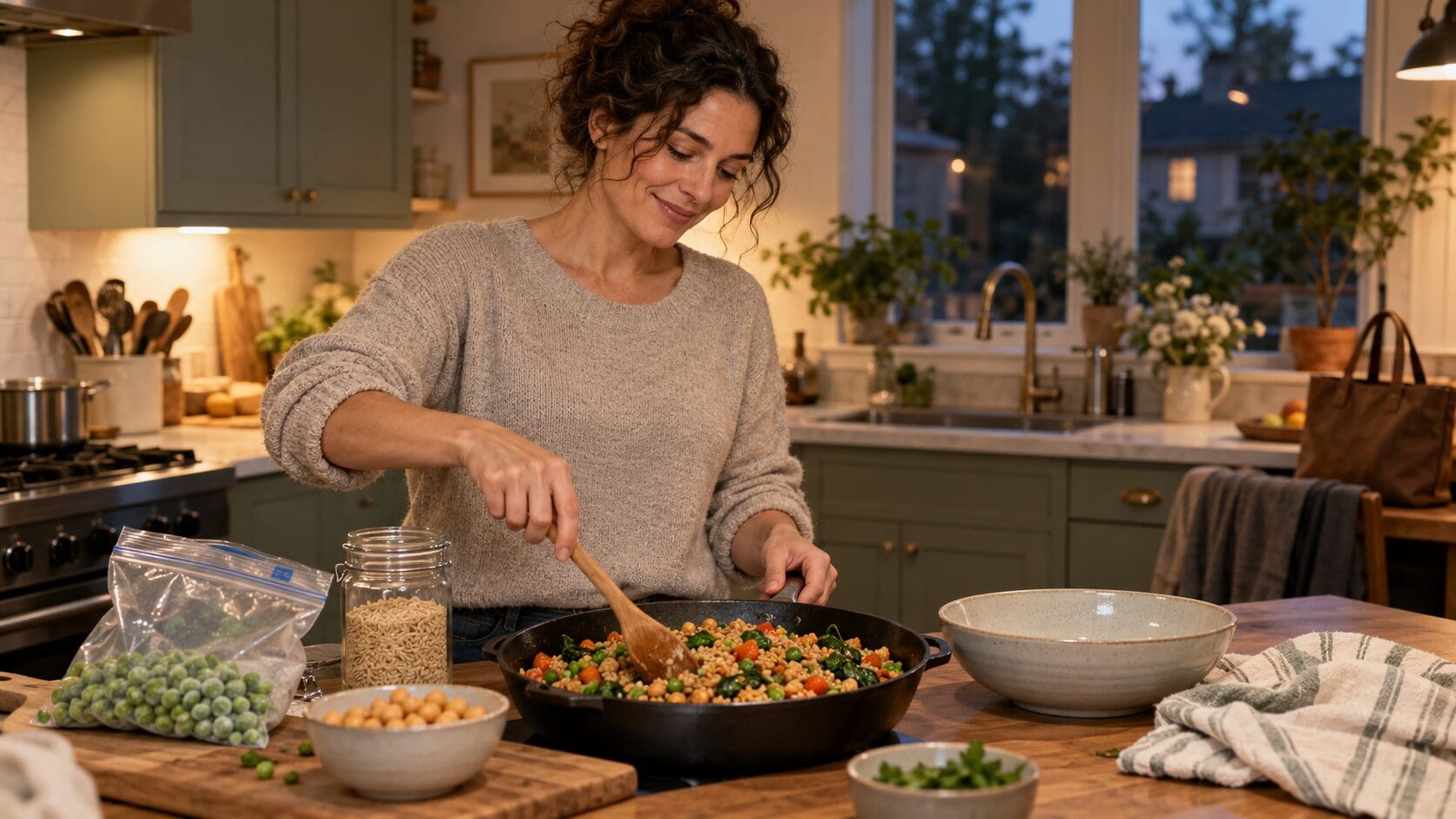
Lena got home at 6:42 with a laptop bag, wet shoes, and a highly ambitious plan to have already eaten dinner.
The freezer offered vegetables. The cupboard offered beans. Her phone offered a headline about ultra-processed foods and children’s brains.
For a moment, even the frozen peas looked suspicious.
Then Lena read past the headline. Dinner could wait another minute. A pantry purge could wait considerably longer.
What the study found, and what it did not
A Children’s Hospital Los Angeles-led study in the August 2026 issue of The American Journal of Clinical Nutrition examined ultra-processed-food intake during early childhood. Its MRI analysis, involving 79 six-year-olds, found that higher cumulative intake was associated with smaller volumes in several brain regions. The researchers did not find an association with measured cognitive performance at ages two or six. Read the research abstract (https://www.sciencedirect.com/science/article/pii/S0002916526001590) and CHLA’s summary. (https://www.chla.org/blog/experts/research-and-breakthroughs/ultra-processed-foods-linked-brain-differences-young-children)
This was an observational study, not an experiment assigning children different diets. It cannot establish that the foods caused the brain differences, and it does not show that an individual child was harmed by a particular snack. The long-term meaning needs more research. The study did not test That Green Juice.
That is worth understanding without turning dinner into a panic response.
Convenient covers a lot of ground
Chopping, cooking, and freezing are all forms of processing. A bag of plain frozen vegetables does not become ultra-processed simply because it is convenient. The Nova framework used in food research distinguishes levels and purposes of processing. Its developers include freezing among methods used for minimally processed foods. Read their explanation. (https://www.cambridge.org/core/journals/public-health-nutrition/article/ultraprocessed-foods-what-they-are-and-how-to-identify-them/E6D744D714B1FF09D5BCA3E74D53A185)
The practical move is to look at the food, how it is made, and the rest of the meal. A package alone cannot answer those questions.
Three ways to keep convenience useful
1. Build a shortcut meal you already like.
Keep a few ingredients that work together: frozen vegetables, beans, and a grain you enjoy, for example. Follow the cooking and storage directions. Lena’s version became a bowl with the vegetables and beans she had, plus leftover rice. It did not need to be photographed to count as dinner.
2. Compare the details, not just the claims.
When choosing between similar packaged foods, check the ingredients and compare Nutrition Facts using similar serving amounts. Look at fiber, sodium, and added sugars together. The FDA’s label guidance supports using those details to make an informed comparison. Avoid treating one impressive claim on the front as the whole story. See the label guide. (https://www.fda.gov/food/nutrition-facts-label/how-understand-and-use-nutrition-facts-label)
3. Choose your own ready-made options deliberately.
For adults who want a smoothie alongside other food, That Green Juice offers a frozen whole-food option. Read the ingredients, follow the bottle’s thawing and consumption instructions, and check the safety information. Consider it for convenience and your preferences, not as a way to reproduce, reverse, or prevent any finding from the children’s study.
Lena sat down with dinner and put the phone away. Tomorrow she might compare a familiar product or add another easy meal to her list. Tonight, the freezer had helped her cook.
The peas were cleared of suspicion. The wet shoes were still a problem, but that was outside dinner’s job description.
Looking for a smoothie option for your adult routine? Shop the That Green Juice Mixed 6-Bottle Pack. (https://thatgreenjuice.com/product/that-green-juice-mixed-6-bottle-pack/)
Product note: The current Original product page carries an unpasteurized-product warning, including particular risk for children, older adults, and people with weakened immune systems. Review the current product safety information before ordering. This article does not recommend TGJ for children.